Webinar Recap: Rethinking Healthcare Velocity
6 mins read
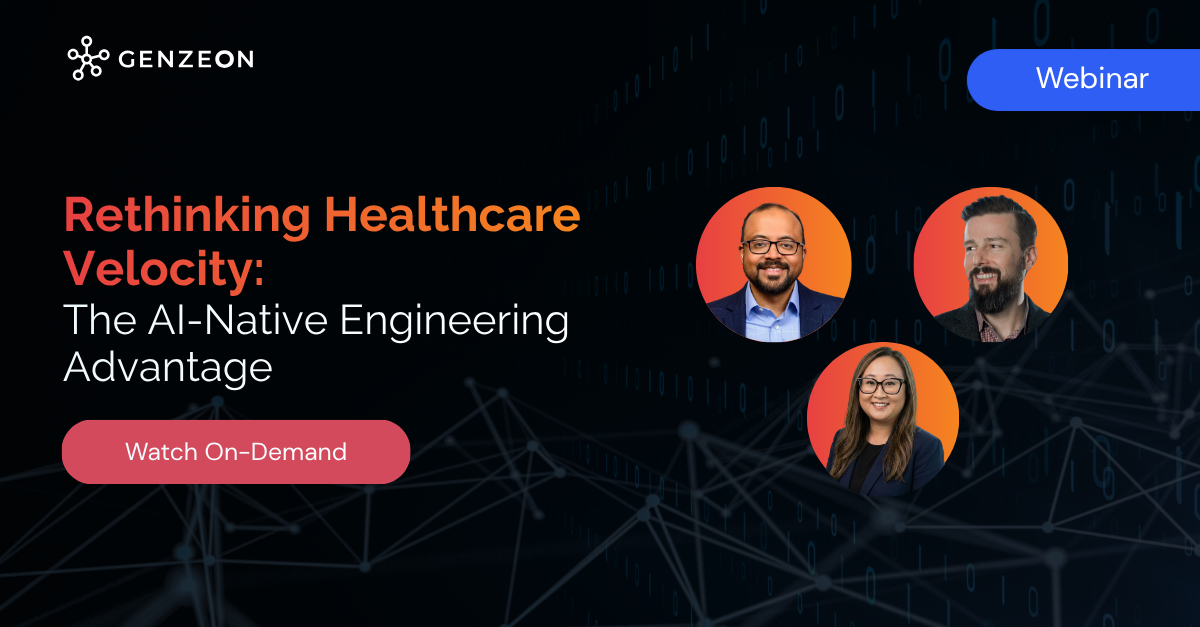
On July 16, engineering leaders from Genzeon and Sharecare sat down for a candid conversation about a shift reshaping healthcare software: the move from teams that use AI tools to teams that are genuinely AI-native. The through-line was simple but hard-won — AI-native engineering is no longer a competitive edge; it is fast becoming the baseline for velocity, and the organizations that redesign around it now will define the next decade of healthcare engineering.
The session was moderated by Pranita Rai, Client Partner & AVP, Healthcare at Genzeon, in conversation with Douglas Jones, Sr. Director of Engineering at Sharecare, and Prashant Krishnakumar, CTO Services at Genzeon. Together they walked through the real journey behind a Sharecare Health Data Services engagement — grounded in four themes: people, process, technology, and governance.
Prashant Krishnakumar framed the market as a spectrum. At one end sit organizations still experimenting — individual developers with their own licensed AI tools. At the other, a small group has gone fully AI-native. Most companies are stuck in the middle, in what he called the “power-tool era”: every developer has a capable tool, but there’s no shared standard, no project context, and no governance. That’s exactly where risk creeps in — shadow AI, inconsistent quality, and tools touching data they shouldn’t.
The gap between those two ends is widening quickly. The teams that cross from individual productivity to team-level velocity — without creating a compliance problem — are the ones seeing an outsized impact.
The healthcare compliance community gathered in Orlando this spring for HCCA’s 30th Annual Compliance Institute, and one force dominated every session: artificial intelligence. For compliance officers and privacy professionals, the message was unmistakable. The window for passive observation has closed. AI governance is now a real compliance obligation.
Both speakers were emphatic in sequence: people come first. Adoption should never begin as a mandate. As Douglas Jones put it during the session, people had to want it before they were told to — curiosity scales; mandates don’t. Sharecare started by curating a strong team, investing the first six months in training senior engineers to use AI responsibly, and letting early champions become the trainers for everyone else.
Prashant Krishnakumar described this as moving engineers up a ladder — from AI-curious to AI-aware to AI-practitioner — which starts with learning an entirely new vocabulary: agents, skills, MCP servers, context windows, orchestration, guardrails, evals, and token economics. Only once teams speak that language can they build systems around it.
“AI-native” is not taking the human out of the loop. In AI’s current state, the human is more critical than ever.”
Douglas Jones — Sr. Director, Engineering, Sharecare
For roughly 30 years, the software development lifecycle has been designed around human throughput — sprint sizes, review queues, and handoffs all scaled to what people can read and pass between roles. When AI becomes the fulcrum of that process, every one of those assumptions changes. Requirements become specs an agent can execute against. Code review shifts from “did you write this correctly?” to “did the agent build what we intended?” Testing stops being a phase and becomes a continuous gate, with telemetry and evals feeding back into the agents.
At Sharecare, that redesign runs end to end: product teams use AI to shape requirements and business cases; technical teams generate high-level designs, estimates, and even stubbed-out Jira tickets before handing work to developers — who then build faster than ever, always inside a rigorous QA and human-review process. The destination Prashant Krishnakumar keeps returning to is the “software factory”: agents doing the heavy lifting while humans own intent, specs, acceptance criteria, and evals.
Maturity progression: L2 Power-tool era → L4 Agentic → L5 Autonomous
“Instead of asking, ‘Where can we insert AI into a process?’ you ask, ‘If AI is at the center, what does the process around it need to look like?’ That’s the difference between retrofitting and redesigning.”
Prashant Krishnakumar — CTO Services, Genzeon
If the SDLC is being rebuilt, governance has to be rebuilt with it. The old model assumed people at both ends of every gate; a software factory where agents plan, code, and test, producing output faster than any human review cadence was designed for. Genzeon anchored its governance in the NIST AI RMF and ISO 42001 frameworks, layered on top of Sharecare’s existing HIPAA-compliant, HITRUST-certified foundation.
Three non-negotiables held throughout: a human always in the loop, zero PHI in prompts, and nothing to production without review. Just as important were the environment secured inside the firewall with scanning to ensure no sensitive data escapes — and disciplined token economics, matching the right-sized model to each task rather than defaulting to the most expensive frontier model for routine work.
Real numbers from the engagement, as shared during the session.
| 30–40%
More delivered than originally scoped (Q1 2026) |
15–20%
Sprint velocity uplift per developer |
| 25% YoY
Velocity gains, sustained across periods |
95%
Root-cause confidence in production, AI-assisted |
Neither speaker pretended this happened overnight. Sharecare moved deliberately through a crawl-walk-run maturity curve, and the current frontier is shifting the bottleneck from writing code to QA and validation — a fresh “shift-left” challenge for producing AI-generated code that arrives at QA with very few defects. The pattern Genzeon sees with clients is consistent: most organizations sit at L2 today, and the work is moving them toward L4 and L5, laying the foundation in three to four months and scaling from there. With AI, a working proof of concept that once took four to six weeks can now be validated in two.
“Whether or not you embark on this journey with us, what matters most is to get started — because the teams that move now will define the next decade of healthcare engineering.”
Pranita Rai — Client Partner, AVP Healthcare, Genzeon
About the engagement.
Genzeon is a healthcare-focused AI and automation company partnering with payers, providers, health-tech, and life-sciences organizations. This session featured the Sharecare Health Data Services engagement as a live case study in AI-native engineering.