From Data Chaos to Intelligent Operations: How Microsoft Fabric IQ Accelerates Data Modernization for Healthcare Payers
7 mins read

Healthcare payers are sitting on more data than ever and still struggling to act on it fast enough. U.S. healthcare spending hit $5.3 trillion in 2024, according to the latest CMS figures. Two landmark studies on the problem still hold up too: a 2019 *JAMA* analysis found that roughly a quarter of U.S. healthcare spending — $760–935 billion a year — is waste, and a 2021 McKinsey study calculated that administrative simplification alone could save $265 billion annually. No comparable study has replaced either since, which is why they remain the reference points most analysts still cite. Layer a genuinely current pressure tightening CMS Star Ratings, growing interoperability mandates, and members who expect faster service — and “doing more with the same data” isn’t a slogan; it’s survival.
At Genzeon, we’ve spent the last year working closely with Microsoft Fabric IQ to help payer organizations solve exactly this problem. Here’s what we’ve learned, and why we built FORGE, our Fabric Ontology Readiness Gateway for Enterprise Payers to make it real faster.
Most payer organizations run member, claims, pharmacy, and clinical data across 15 or more siloed systems, with no unified view connecting them. That fragmentation shows up everywhere:
None of this is news to anyone running payer operations. What’s changed is that there’s now a practical way to fix the root cause, not by ripping out core systems, but by adding a layer of shared meaning on top of them.
Think of Fabric IQ as a shared brain for your payer organization — one that understands what a member, claim, provider, and authorization mean, and how they relate. It sits on top of your existing systems rather than replacing them: your data stays where it is, and Fabric IQ adds a semantic intelligence layer above it.
Fabric IQ is built from six components that work together as one integrated system:
Ontology and Graph form the foundation layer. Data Agent and Operations Agent form the intelligence layer that draws from it. Planning and the Power BI Semantic Model form the consumption layer. It’s one integrated system, not six disconnected tools.
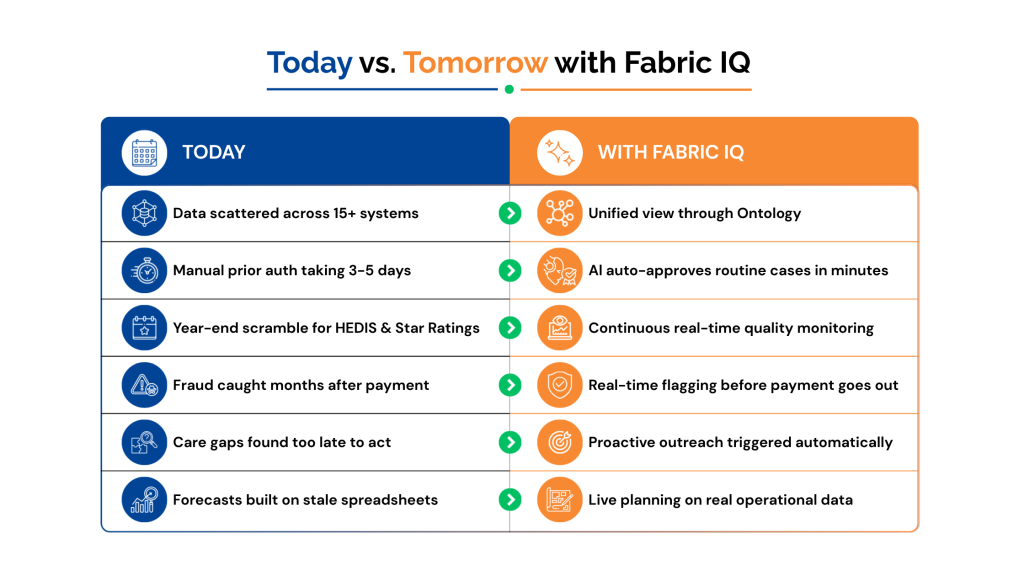
Here’s the catch. Most payer Fabric IQ projects don’t stall on the technology — they stall on ontology design, because deep payer domain knowledge and platform expertise rarely live inside the same team. Building a payer ontology from scratch typically takes three to six months. Mapping Member, Claim, and Provider entities across a dozen-plus source systems is manual, generic agent prompts need extensive tuning before they’re safe for clinical use, and compliance often gets bolted on after the fact instead of built in from day one.
FORGE, our Fabric Ontology Readiness Gateway for Enterprise Payers, is six purpose-built components that accelerate every phase of a Fabric IQ implementation:
FORGE doesn’t replace Fabric IQ — it’s the accelerator that makes it stand up correctly and quickly, achievable within a fixed scope and budget.
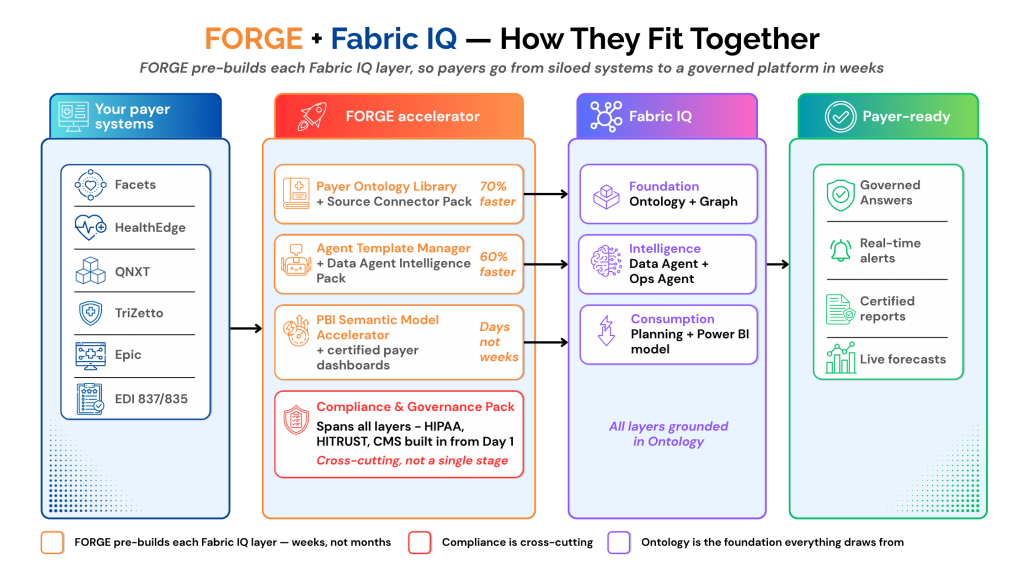
Genzeon brings 12+ years of payer implementation experience across HEDIS, Star Ratings, risk adjustment, prior authorization, and claims, along with certified delivery across Fabric IQ, OneLake, Power BI, Azure ML, and Purview. With 75+ payer clients, we’re not learning what a Member, Claim, or HCC Gap means in production — we already know. We work as an accountable partner across the full lifecycle: data estate readiness, ontology design, agent configuration, and managed services. When Fabric IQ surfaces underlying data quality issues, we fix them rather than pointing back at the client.
For payers who want to see this in action before a full rollout, Genzeon offers a 6-week Quickstart engagement. It enables a Fabric IQ workspace on your Azure tenant, builds an ontology for one selected use case (Star Ratings, fraud detection, or Member 360, for example), connects up to three data sources via OneLake, and configures one Fabric Data Agent plus one Activator-powered monitoring workflow — all delivered using FORGE rather than built from a blank canvas. It’s a focused, fixed-fee engagement that ends with a working demo, a UAT sign-off report, and a roadmap for production.
Fabric IQ gives payers a genuine, shared understanding of their data — the ontology, relationships, and governed intelligence that turn 15+ disconnected systems into one coherent operating picture. FORGE turns that foundation into a matter of weeks, not months, without sacrificing the payer-specific accuracy and compliance with healthcare demands. Together, they turn “the cost of doing nothing” into a clear, achievable path forward.
Interested in seeing what a Fabric IQ Quickstart could look like for your organization?
Schedule a Fabric IQ Readiness Assessment to identify your highest-value use case and receive a roadmap for a 6-week Quickstart.