Day 2 Adoption: Turning Healthcare Automation Into Sustained Operational Value
8 mins read
For most healthcare organizations, the question is no longer whether to automate. That decision has largely been made. The platform has been purchased, the pilot has been run, the first workflows are live, and somewhere there is a slide showing the hours saved.
Healthcare has spent the last several years proving that automation and AI can work. The harder question, and the one that ultimately determines whether the investment matters, is what happens next.
Because everyone celebrates the go-live. Nobody celebrates the ten-thousandth prior authorization.
At Genzeon, we call this Day 2 Adoption: the work required to make automation reliable, trusted, measurable, scalable, and valuable long after launch. Day 1 is visible. It is the build, the integration, the launch, and the early success. Day 2 is everything that follows: the automation still running correctly on its ten-thousandth transaction, the agent handling an edge case that was never scoped during the pilot, the second and third departments adopting the same capability, and the value still showing up in operating reviews years later.
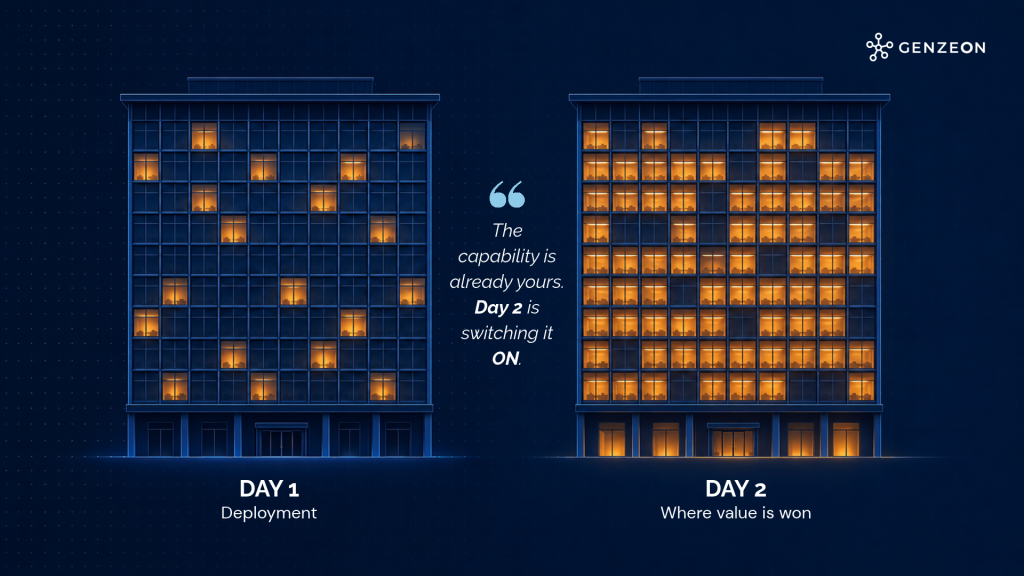
Day 2 is where automation either compounds or quietly stalls. And the uncomfortable truth is that automation rarely fails loudly. More often, nothing visibly breaks. The workflow remains live, the licenses renew, and the dashboard still exists, but the automation is processing only a fraction of the volume it was designed for. Exceptions accumulate, users create manual workarounds, expansion slows, and the business case gradually becomes disconnected from operational reality.
Nobody calls it a failure because nothing was switched off. The value stopped scaling.
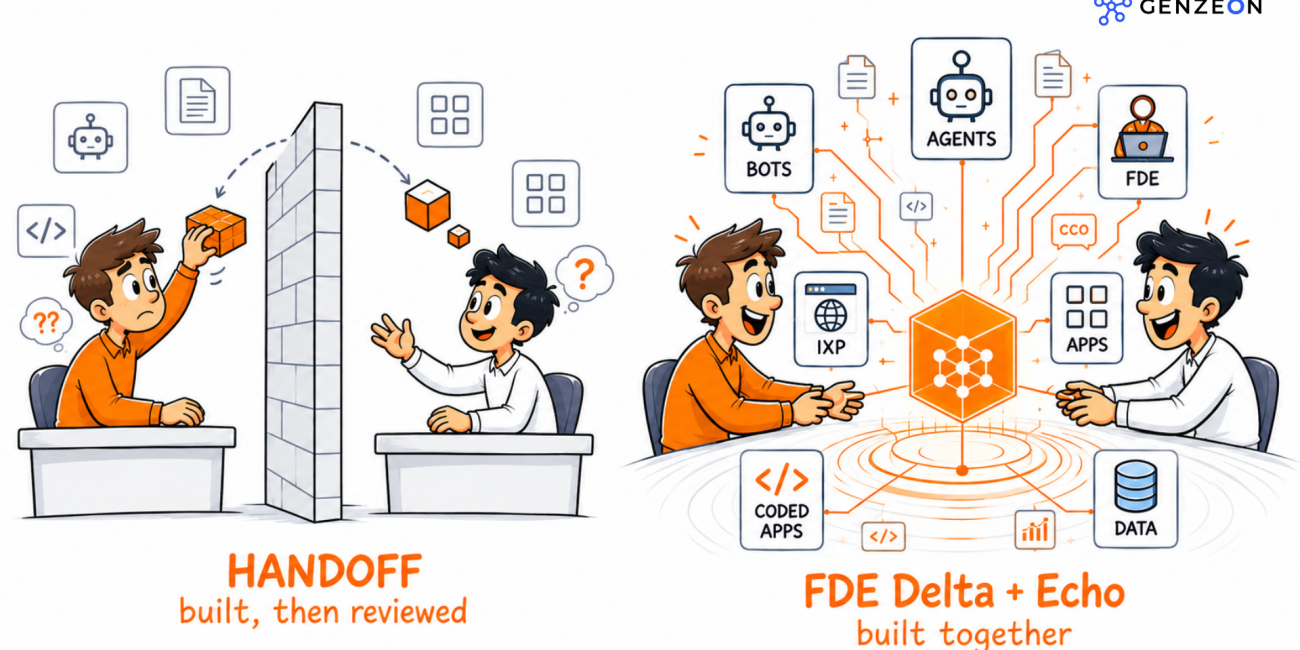
Ask a healthcare operator where the problems actually live, and the answer is rarely the platform. It is usually the handoff.
A referral gets lost between a primary care physician and a specialist. A prescription refill stalls because a step fails silently. A prior authorization is approved, but the patient is still standing at the pharmacy counter being told to pay. In many of these situations, the systems are technically connected, but the workflow is not.
Healthcare operations are full of rules, exceptions, human judgment, payer-specific requirements, clinical preferences, compliance constraints, and processes that have evolved over years of real-world use. Automation built without a deep understanding of those realities can be technically correct and still be operationally fragile. It may survive the demo, but it does not necessarily survive the volume.
That is one reason so many automation programs struggle after go-live. The technology may be capable, but the workflow logic is only almost right and good enough for a pilot, but not resilient enough for the exceptions that emerge at production scale.
This is also why Day 2 Adoption cannot begin after launch. It has to be designed into the workflow from the beginning.
Your systems are connected. But are your workflows?
When adoption is treated as an objective rather than an afterthought, the automation journey changes. The progression is simple: Deploy → Adopt → Scale → Optimize → Expand. Deployment puts the capability into production. Adoption means the people doing the work trust the output enough to rely on it. Scale means subsequent use cases become easier because they inherit what has already been built. Optimization means performance is monitored and improved continuously. Expansion means the capability moves across the organization according to the customer’s priorities and pace.
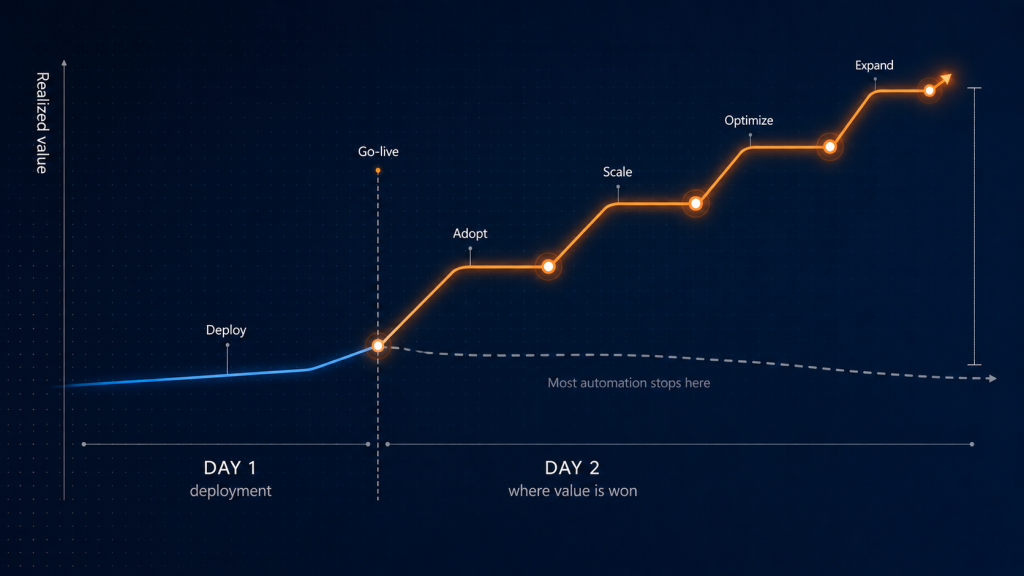
The goal is no longer simply to launch automation. It is to create an operating capability that becomes more valuable over time.
At Genzeon, one operating model shapes this approach more than any other: our healthcare-focused Forward Deployed Engineer model.
Every engagement pairs an automation engineer with a credentialed healthcare operator throughout the build. Rather than bringing in a subject matter expert at the end or consulting one only during discovery, the operator works alongside the engineer while the workflow is being designed. They challenge the logic, validate exception paths, and help ensure the automation reflects how healthcare operations actually work before anything reaches production.
Depending on the workflow, that expertise may come from a former claims leader, revenue cycle professional, certified coder, prior authorization specialist, or another healthcare operator with direct domain experience. That pairing matters because domain correctness at the point of build is what helps automation hold up three months and three thousand transactions later.
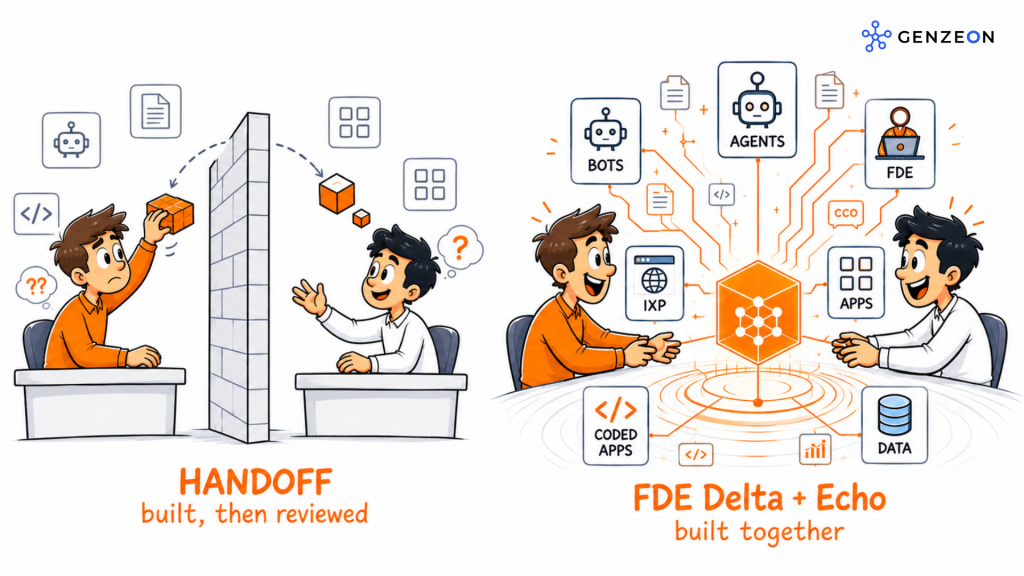
The model is reinforced by Genzeon’s healthcare-specific IP: accelerators, agent patterns, exception-handling models, and human-in-the-loop designs built from healthcare delivery. The engineer isn’t starting from a blank canvas, and the operator isn’t explaining the domain from first principles.
That changes both speed and economics. Rather than treating every automation as a standalone project, reusable assets let each use case start further along — patterns, integrations, governance, and operational knowledge carry forward, which is why the tenth automation is fundamentally different from the first.
The same principle applies to measurement. Day 2 cannot be managed if value is only defined at launch. The benefit has to be established early and tracked in the same operating terms throughout — processing time, exception rates, throughput, accuracy, or capacity returned to clinical teams. The metric differs by organization; the discipline shouldn’t. The business case that justified the investment should still be the one being measured long after go-live.
There’s also a second question organizations eventually face: who operates this on Day 2?
It decides whether automation is continuously improved or gradually decays, whether the next use case takes six months or six weeks, and whether the capability becomes something the organization genuinely owns. There’s no single right structure. Some are evolving automation CoEs into broader AI and automation CoEs; others use dedicated delivery pods or embed engineers directly into their teams.
So we don’t prescribe one. Automation can run through a managed Center of Excellence, dedicated delivery pods, or embedded Forward Deployed Engineers working inside your teams.
What matters more is the direction of travel. Our engagements move deliberately from fully managed to co-managed to client-led, at whatever pace makes sense. The intent is not to remain indispensable — it’s to leave behind a capability the customer can operate, extend, and scale.
That’s one of the clearest tests of whether a partner believes in Day 2, or is simply selling Day 1 twice.
Ultimately, Day 2 Adoption should show up in outcomes that healthcare organizations actually care about. It should look like workflows continuing to perform under real production volume, fewer exceptions requiring manual intervention, new use cases reaching production faster because infrastructure and governance already exist, and agents moving beyond proof of concept into daily operations.
Most importantly, it should return time to clinical and administrative teams who were never hired to chase broken handoffs or repetitive workflows in the first place.
Over the coming quarters, Day 2 Adoption will be a central lens for how Genzeon talks about healthcare automation and AI. We will explore the workflows where adoption matters most across payer operations, provider operations, and life sciences. We will share examples of organizations moving from individual automations to durable operating capabilities. And we will continue asking a question we believe the industry needs to ask more often: not only “What can we automate?” but “What have we already automated that is not yet delivering its full value?”
When healthcare organizations think about what UiPath can actually do for their operations, we want Genzeon to be the name that comes to mind. Not because we deploy the platform, plenty of partners do, but because we’re among the few UiPath entrusts to co-develop healthcare products, and because we stay to make the platform deliver.
We will also bring this conversation to UiPath FUSION 2026 in Las Vegas, where the Genzeon team will demonstrate agentic healthcare solutions across payer, provider, and life sciences environments. If you are attending and want to discuss where your automation program may be getting stuck between deployment and adoption, connect with Vinit Singhal and the Genzeon team.
Healthcare has already spent years proving that automation can work. The opportunity now is to make sure it keeps working — reliably, at scale, long after deployment.
Genzeon is a healthcare AI, data, and automation company serving payer, provider, and life sciences organizations. We combine deep healthcare domain expertise with agentic automation and AI engineering to help healthcare organizations move beyond deployment and toward sustained operational value.
Our teams deliver through a healthcare-focused Forward Deployed Engineer model that pairs credentialed healthcare operators with automation engineers, supported by healthcare-specific accelerators, reusable assets, and platforms designed for regulated, multi-system healthcare environments. Our work spans prior authorization, claims operations, revenue cycle, patient access, laboratory workflows, and other complex healthcare processes where operational reliability matters as much as technical capability.