From Orlando to Operations: Key AI and Privacy Takeaways from HCCA 2026
5 mins read
The healthcare compliance community gathered in Orlando this spring for HCCA’s 30th Annual Compliance Institute, and one force dominated every session: artificial intelligence. For compliance officers and privacy professionals, the message was unmistakable. The window for passive observation has closed. AI governance is now a real compliance obligation.
The 2026 Compliance Institute spanned more than 100 sessions across 14 learning tracks, with AI embedded across every domain from data governance to regulatory enforcement. What stood out wasn’t the volume of coverage, but the shift in tone: speakers moved beyond aspirational use cases into the operational realities of risk, liability, and accountability.
The consistent challenge from the floor: AI systems are ingesting sensitive health data across workflows never designed to govern it. Legacy compliance controls are increasingly inadequate for AI-generated data flows.
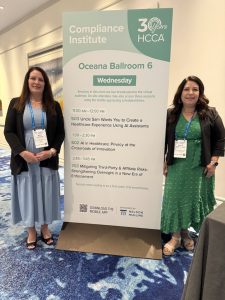
Micki Jernigan with Sallie Bissette before their session (AI in Healthcare: Privacy at the Crossroads of Innovation)
Throughout sessions, industry leaders converged on several foundational principles for sound AI governance in healthcare compliance environments:
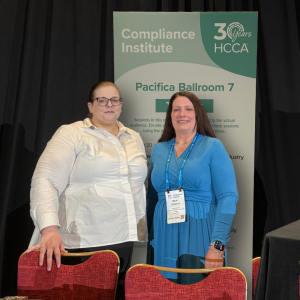
Micki Jernigan with Elizabeth McElhiney before their session (The Alphabet Soup Diet: Surviving CMS, OCR, OIG, DOJ, and ONC Without Indigestion)
Do you integrate with other platforms? Yes, CPS integrates with EHR systems, HR platforms, and document management tools.
What if I have locations in multiple states? CPS is built for multi-site organizations, managing incidents, BAAs, and risk assessments across all locations from one platform, with regional and facility-level reporting. Our framework accounts for varying state breach notification requirements.
How does pricing work for smaller organizations? CPS is a SaaS-based solution with no heavy upfront investment and predictable costs that scale with your size. Organizations like Anderson Healthcare, with small privacy teams, have found it cost-effective from day one.
What does the platform offer for compliance? Incident tracking, workplan management, automated risk assessments, excluded party screening, hotline services, conflict of interest disclosure processing, and trend dashboards. For AI adoption, CPS also supports AI governance readiness, assessing and documenting the organization’s AI readiness and producing a mitigation plan to reach maturity.
While an AI governance framework is on the CPS roadmap (stay tuned!), find out below how CPS is helping its customers automate privacy and compliance
Anderson Healthcare — Strategic Bandwidth Through Automation: This regional Illinois health network replaced entirely manual privacy incident and BAA processes with CompliancePro Solutions — giving leadership visibility into organization-wide trends for the first time and freeing the privacy team to focus on education and policy improvement instead of paperwork.
“Before CPS, there was no way for me to give leadership the big picture of ‘How are we doing as a whole with privacy?'” — Ashley Brown, Director of Compliance & Privacy
Academic Health Center — 3x Faster Incident Closure: A 900-physician academic health center ditched spreadsheets and faxes for CPS and immediately saw investigation closure times drop from nearly 60 days to just 16–17 days, a 3x improvement — while department dashboards gave clinic managers real-time visibility into their own HIPAA compliance posture.
“It is the first thing that I would not remove from my budget.” — Privacy Officer
Large Academic Medical Center — Rebuilding After a Breach: After a breach affecting 500+ patients exposed to a fragile, homegrown incident tracking system, this 10,000-employee, 150-location health system turned to CPS. Automated workflows, integrated dashboards, and data-driven risk assessments replaced manual processes and transformed reactive breach response into proactive pattern-based prevention.
“Operating without a solution like CompliancePro Solutions is like asking the business to operate without Word or Excel.” — HIPAA Privacy Officer
The common thread: automated, insight-driven privacy management is the foundation that makes AI governance possible, but not the other way around.
HCCA 2026 confirmed it: AI governance in healthcare is today’s compliance imperative, not tomorrow. Organizations that treat it as a side project will struggle to demonstrate defensible practices when enforcement of pressure arrives, and that pressure is intensifying.
Genzeon/CPS sits at the intersection of AI enablement and healthcare compliance. The question is no longer whether AI will transform your compliance program. It is whether your program is ready to govern it.
About CompliancePro Solutions:
CompliancePro Solutions is the privacy, compliance, and AI-governance platform purpose-built for healthcare. Automate the full privacy lifecycle from incidents, risk assessments, breach reporting, BAA tracking, disclosures, policy enforcement, and govern the AI now entering every healthcare workflow with structured AI Readiness Assessment, AI Risk Assessment, and continuous AI policy enforcement.